Exército Brasileiro decide adquirir aviões C-23B Sherpa

Seção principal do AeroFórum para troca de informações.

Moderador: Moderadores

Regras do fórum
As regras do fórum estão disponíveis CLICANDO AQUI.
jambock
MASTER
MASTER
Mensagens: 2461
Registrado em: Seg Dez 20, 2004 16:37
Localização: Porto Alegre/RS
Contato:

Exército Brasileiro decide adquirir aviões C-23B Sherpa

Mensagem por jambock »

Meus prezados
Mercado de Usados: Exército Brasileiro decide adquirir aviões C-23B Sherpa
Imagem
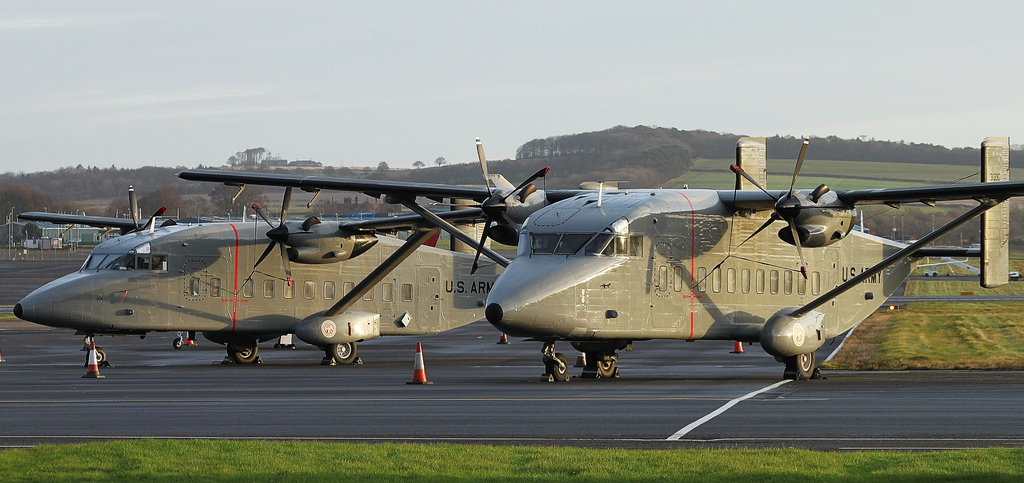
Após vários estudos e análises visando a aquisição de uma aeronave afim de dotar o Exército Brasileiro de capacidade logística através da operação de “asa fixa”, o Exército Brasileiro finalmente definiu sua opção pelo C-23B Sherpa de segunda mão oriundos dos estoques norte americanos do AMARG.
O C-23B Sherpa foi o escolhido dentre três aeronaves avaliadas pelo Exército Brasileiro, sendo os outros concorrentes o Viking DHC-6 Twin Otter 400 Series, apontado pela nossa equipe como um dos melhores para atender ao Exército brasileiro, levando em consideração seu custo de aquisição e operação, além é claro do desempenho excelente em pouso e decolagem em pistas curtas e rústicas, outro forte candidato foi o Sikorsky/PZL M-28, versão oferecida através da parceria com a polaca PZL e a gigante norte americana, apresentando uma excelente pontuação em sua avaliação e oferecendo uma ótima capacidade de operação em pistas curtas, aliado ao baixo custo operacional e apresentando rampa traseira. Ambos concorrentes dos vetustos C-23B Sherpa, seriam aeronaves novas e no estado da arte.
Imagem
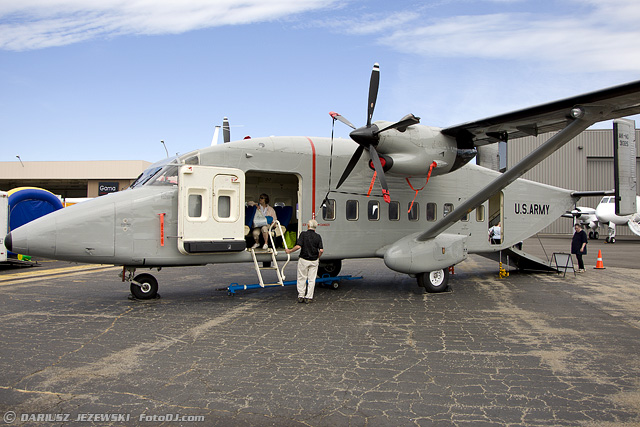
C-23 Sherpa 93-1325 from AK-NG
O EUA através de sua oferta via FMS, disponibilizou 15 células afim de atender as necessidades do Exército Brasileiro em retomar suas capacidades logísticas após 76 anos sem operar aeronaves de asa fixa, porém, o COLOG foi mais cauteloso, onde irá adquirir inicialmente apenas 4 aeronaves do tipo, tendo em vista sua dotação orçamentária, onde tal aquisição irá conseguir desenvolver a doutrina operacional de asa fixa sem impactar em sua capacidade já muito limitada orçamentária á manter a operação das mesmas e de seus helicópteros.
Na última sexta feira (25), dia em que se comemora o “Dia do Soldado”, o comandante do Exército Brasileiro, o General Eduardo Villas Boas Correia, assinou o despacho que dá como decidida a aquisição dos C-23B Sherpa pelo Exército Brasileiro, lançando a pedra fundamental no retorno da operação de asa fixa pela força terrestre brasileira.

Imagem
Os “Sherpa” tem previsão de operar no Brasil sob o cocar do Exército Brasileiro por cerca de 15 anos, sendo o primeiro entregue após um extenso processo de revisão e modernização, sendo a entrega prevista para 2020.
A chegada dos “novos” C-23B irão reduzir significativamente os custos logísticos do EB, que hoje em muito depende do fretamento de aeronaves civis para atender suas necessidades, uma vez que a Força Aérea Brasileira tem apresentando limitações á prover o suporte necessário ao Exército Brasileiro.
Esperamos que a escolha venha a cumprir com o que se espera, e tenhamos uma bem sucedida retomada da operação com aeronaves de asa fixa pelo EB, com um melhor atendimento aos batalhões de fronteira e outras unidades militares
Fonte: Ghost para site Plano Brasil 29 AGO 017
Um abraço e até mais...
Cláudio Severino da Silva
jambockrs@gmail.com

Na aviação, só a perfeição é aceitável
FCM
MASTER
MASTER
Mensagens: 7548
Registrado em: Sex Dez 24, 2004 12:26
Localização: Porto Alegre

Re: Exército Brasileiro decide adquirir aviões C-23B Sherpa

Mensagem por FCM »

Variação do Short 330.

Na infância eu, meu irmão e nossos pais voamos no Short 330 D-CDLB da DLT (voo FRA-SCN em 07/02/1980).
AeroEntusiasta
Fundador
Fundador
Mensagens: 9732
Registrado em: Dom Dez 19, 2004 09:00
Localização: Porto Alegre - RS
Contato:

Re: Exército Brasileiro decide adquirir aviões C-23B Sherpa

Mensagem por AeroEntusiasta »

The Final Army Flight of the C-23 Sherpa

BY STEVEN HOARN - JANUARY 27, 2014

https://www.defensemedianetwork.com


After more than two decades of service as a workhorse for the U.S. Army and U.S. Army National Guard, the C-23 Sherpa is history. Named after the rugged people of Eastern Nepal, few aircraft have been more aptly named than the C-23. Although the C-23 is leaving military service, a handful of Sherpas may find new employ in the wilds of Alaska.

“The C-23 provided disaster relief during hurricanes, the oil spill in the Gulf of Mexico, forest fires, flooding, blizzards and the earthquake in Haiti, and was also used during the Winter Olympics in Vancouver, B.C.”

Manufactured by Short Brothers, before their acquisition by Bombardier in 1989, the C-23 resembles a flying box. The C-23 entered National Guard service in the early 1990s, flying in missions ranging from humanitarian disaster relief to combat support missions. “The C-23 provided disaster relief during hurricanes, the oil spill in the Gulf of Mexico, forest fires, flooding, blizzards and the earthquake in Haiti, and was also used during the Winter Olympics in Vancouver, B.C.,” said CWO5 Clarence Shockley. Shockley serves as an instructor pilot and instrument examiner for the Operational Support Airlift Agency (OSAA). The C-23 also was used in the support of Army parachute-drop training missions.

Besides seeing service in Operation Desert Storm, the C-23 also participated in operations related to Operation Iraqi Freedom and Operation New Dawn. “The C-23 provided limited rear support during the Persian Gulf War,” said Maj. Matthew Moore, chief of future operations with OSAA. “However, it saw continued action from 2003 through 2011, in Operations Iraqi Freedom and New Dawn, often moving half-a-million pounds of cargo a month,” added Moore.

Known for its versatility, if not for its creature comforts, the Sherpa excelled at operating where other aircraft, for a variety of reasons, could not. “A C-130 simply cannot land at every location. Sometimes a CH-47 is too expensive to operate for a light load. IT was another tool that was cost-effective in homeland defense, disaster preparedness, and the Global War on Terrorism,” said Shockley.

“A C-130 simply cannot land at every location. Sometimes a CH-47 is too expensive to operate for a light load. IT was another tool that was cost-effective in homeland defense, disaster preparedness, and the Global War on Terrorism.”

Although not pretty to look at, the C-23 has earned a reputation as a reliable and steady aircraft. To illustrate that point Shockley shared a story of a 2009 flight he was piloting, where the cockpit side window blew out. “It was a little noisy and cold, but where are you going to land when you are over the North Atlantic? We landed in Keflavik, Iceland, without any problem,” said Shockley.

It was Shockley who was part of the crew that flew the final C-23 in the inventory on its final flight. The C-23 was flown from Egypt back to the U.S. and despite delays due to electrical issues and inclement weather, Shockley still found himself waxing nostalgic. “It was a privilege to have had the opportunity to fly the last Sherpa into retirement and the greater privilege was to have served as a crew member with those hardworking quite professionals,” said Shockley.

Although the C-23 has left Army and Army National Guard service, the C-23 may linger on thanks to the National Defense Authorization Act for Fiscal Year 2014 which is transferring 8 C-23s to the State of Alaska. A press release by Rep. Don Young’s (R-Alaska) office says that the transfer of 8 C-23s will, “fill a niche search and rescue and medium-lift need on Alaska’s short rural runways.”

https://www.defensemedianetwork.com/sto ... 23-sherpa/
Responder
